
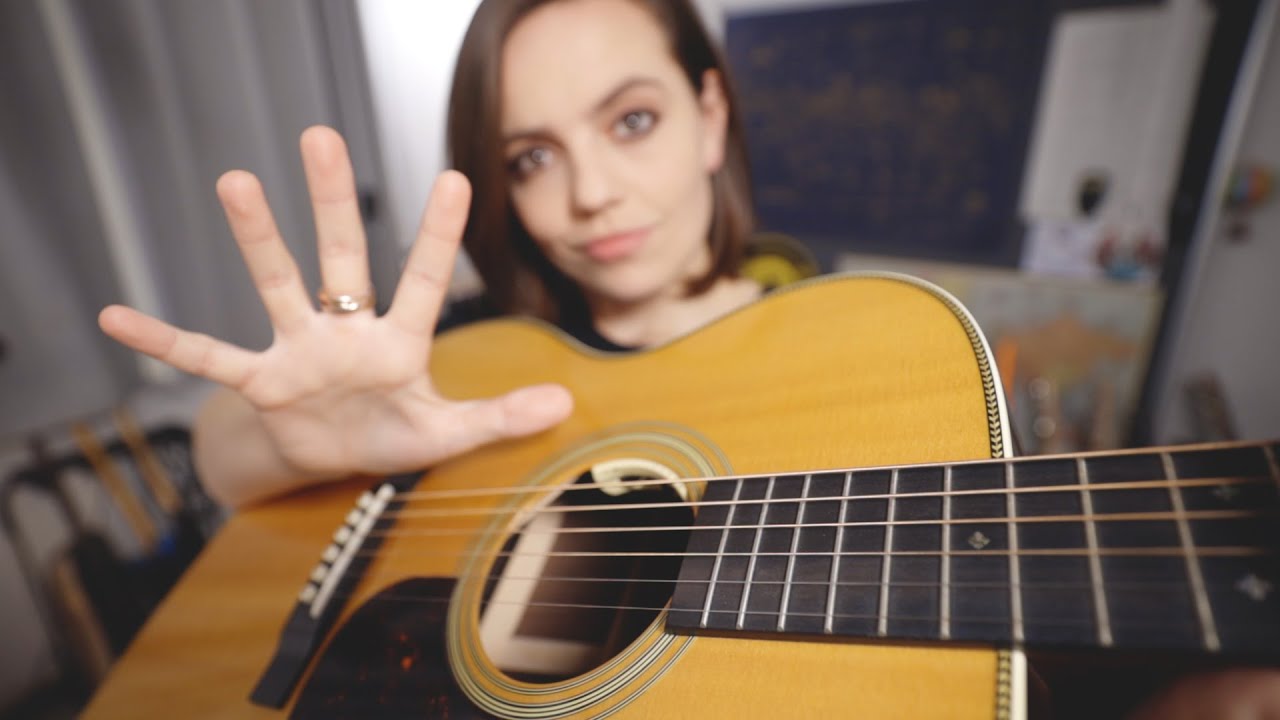
I've played without a pick for well over a decade now. People often ask how I learnt fingerstyle, so I went back through old song books and embarrassing camcorder videos to work out where it really started.
The song that changed my right hand
At university a friend and I entered a charity challenge to get as far from Bristol as possible in 36 hours without spending any money. We ended up in Perth, Australia. On the endless flights I listened to my guitar heroes on repeat: Mark Knopfler, Tracy Chapman, John Mayer, Andy McKee, Kaki King, KT Tunstall and Joni Mitchell.
I was hooked on Andy McKee's percussive style and kept failing to play like him. What I really wanted was a style of my own. I wrote the lyrics for a song, A Never-Ending Winter, on the way home, and I could hear a guitar part in my head that I couldn't yet play. It took days of failing and muddling the right-hand pattern until it finally clicked.
The lesson
Write something that pushes you just past what you can do, then finish it. Putting a new technique into a complete song forces you to play it while singing, and eventually perform it. When I sing and play at the same time I get into a state of flow and stop thinking about my right hand, and it just happens.
I usually work out the proper name for what I'm doing afterwards. That's how I found out I was Travis picking.
So it isn't always about running scales or studying theory. Sometimes it's about telling a story and finding an accompaniment that fits underneath it.
If you're not writing songs yet
Learn songs with properly written-out fingerstyle parts that are hard enough to keep you interested but not impossible. Some good ones:
- Stop This Train by John Mayer
- Landslide by Fleetwood Mac
- Blackbird by the Beatles
A tip on documenting ideas
My early song books only had lyrics: no chords, no tunings, no recordings. Now I always note the tuning and chords and record a voice note. Your future self will thank you.
Start here: Fingerstyle Guitar for Beginners walks you through the patterns I use.