
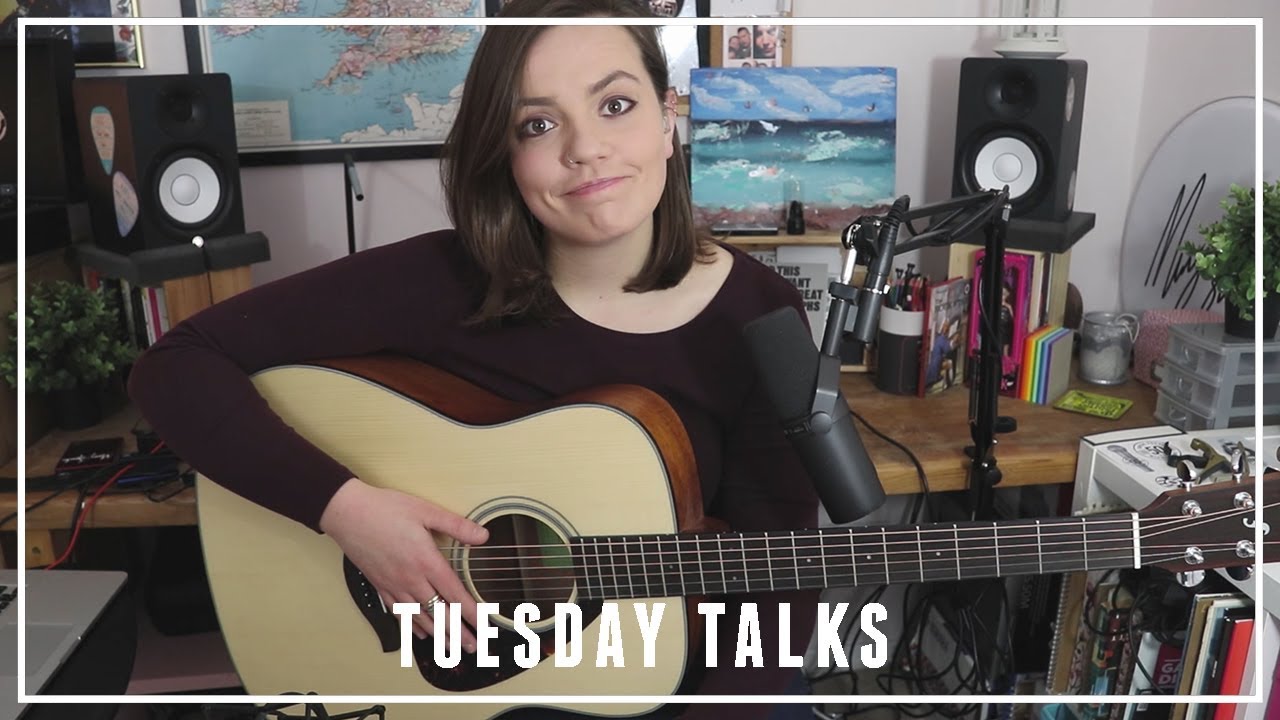
I'd been getting lots of questions about how I write songs, so when I wrote one earlier in the day, I decided to show you the process while it was still fresh. Usually, once you've gigged a song and recorded it, all the ideas that ended up on the cutting-room floor disappear. This was the earliest I'd ever shared a song: just the shell. It became "Run Your Mouth".
At that point I had a rough verse (two, really), a bridge, a chorus and possibly a middle eight. It needed to go somewhere more interesting, but I stopped there to talk you through what I'd done.
It started with noodling
I wasn't practising; I was just mucking about on the guitar. One thing I like to do is sing along to whatever I'm playing. Not a solo, just a little melody. It also tells me where the melody will sit in my range.
The opening came from sliding one finger up and down the B string, a simple effect I love for setting an atmospheric mood before I even knew what the song would be about.
Retuning to solve a problem
Next I started playing a D, and a G with my thumb. But I realised that if I wanted melody higher up the neck, I wouldn't be able to keep reaching that low G. So I tuned my A string down to G (giving E G D G B E). Now the root is on an open string, and I'm free to play higher up the fretboard without losing the bass note. It's the first tuning in my article on four easy alternate tunings.
Lyrics from nonsense
Then I sang, at first, absolutely nothing: just sounds. Eventually words arrived. They still needed work, but they made a nice pattern.
Why voice memos matter
When I came back to it, I got muddled and couldn't fit in all the words I'd already written and knew worked. That's when voice memos saved me. I'd recorded an earlier draft, so I could go back and hear exactly how the phrasing had gone. That's the whole point of voice notes: you can refer back when you can't remember the idea you had.
Watch the syllables
The first verse has a long second sentence with lots of syllables. If you get the rhythm of it even slightly wrong, it just doesn't work. I usually try to avoid lines like that, but I liked the flow of this one, so I kept it and practised it until it sat right.
Writing from life, loosely
I hadn't been sleeping well, so I'd been thinking a lot about sleep: heavy eyelids, someone muttering in your ear when you just want to rest, and having to stay awake. It isn't about anyone specific in my life. It grew into the idea of someone running their mouth: spiteful words that are easily said, and how they hit differently at night.
Adding chords for contrast
The verses and chorus both revolve around D and G, so the bridge needed other chords to make it more interesting. I dropped to a B in the bass, back to G, then down to E before heading into the chorus. That small change of harmony gives the chorus more impact when it arrives. The chorus melody itself came from something I'd been singing to myself earlier, which I then worked out on the guitar.
For more on my songwriting, read how I turned four simple chords into a whole song and facing the blank page, or take my songwriting course.