
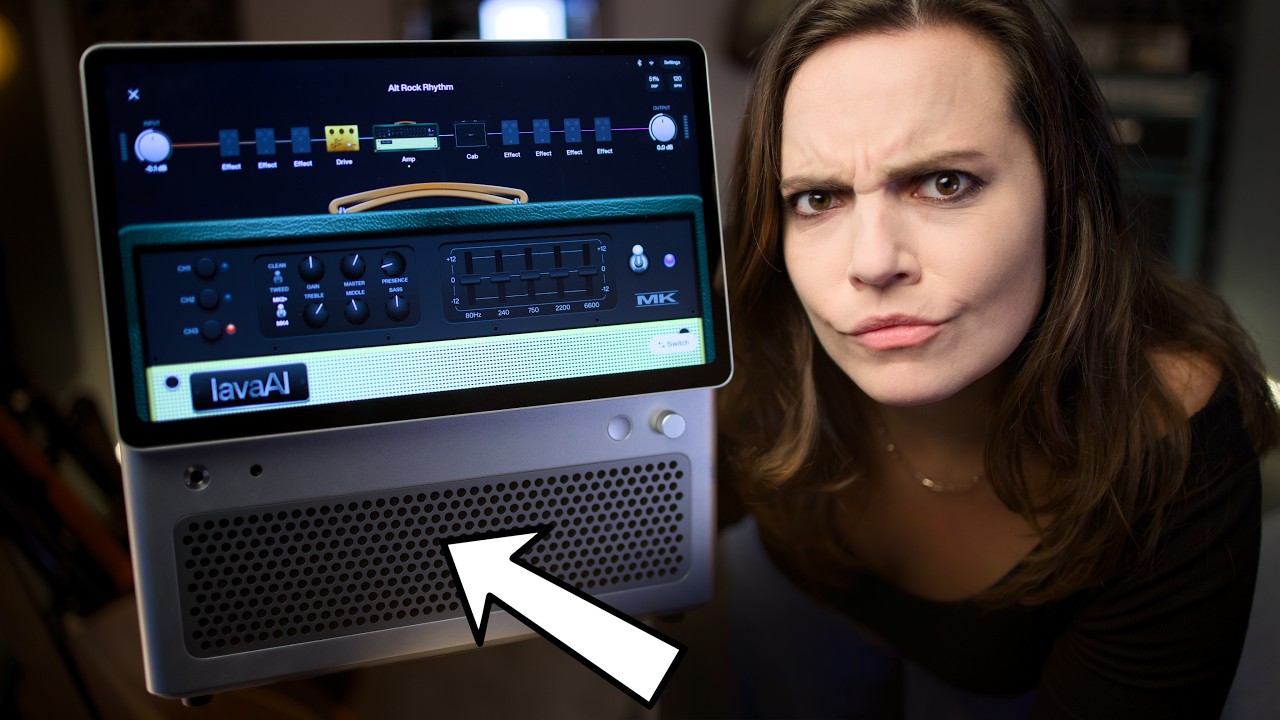
I have a slightly crazy history with Lava Music. In 2019 I made a video about one of their carbon fibre guitars, and it went on to pass five million views. So when Lava approached me to make this sponsored video about the Lava Studio, I was intrigued.
Guitarists have a strange relationship with technology. We like to say nothing has really changed: the electric guitar was perfected decades ago, the best valve amps are still the best, and a great vintage or handmade instrument can't be replaced. I agree, and I don't think the analogue side of guitar is going anywhere. But as someone who loves technology, I'm also a little jealous of what musicians have now. Limitation is valuable when you're learning, but the amount of tech available in one box today is extraordinary.
What it is
The complete set-up, with the stand and footswitch, was just over $1,000 when I made the video. That's a lot of money, and it would have been completely out of reach when I was learning. But inside you get:
- Amp modelling and profiling, including support for NAM (Neural Amp Modeler) profiles, with tens of thousands of amp profiles available. Too many, honestly; nobody needs that many.
- Effects, with your own signal chain of gates, compressors, drives, cabinets, modulation, EQ, delay and reverb
- Interactive tabs, online teachers and hundreds of backing tracks
- Stem separation
- A 2.1 speaker system: dedicated left and right stereo speakers plus a separate bass driver, so it doubles as a proper listening system
The hardware
It's beautiful to look at; if Apple made a guitar amp, it might look like this. The controls are simple: a sleep/wake button, a physical volume knob, a headphone output and a guitar input on the front, with left and right line outputs, USB-C and power on the back. It's about 31cm wide, 20cm tall and 17cm deep, weighs about 4.5kg, and has a magnesium alloy body, a 13.3-inch touchscreen and 64GB of storage. It updates over wifi, so the software can keep improving.
That matters more than it sounds. A piece of gear that's switched on and ready in your living room is a piece of gear that actually makes you pick up the guitar.
How it sounds, and what didn't work
Having so many options becomes genuinely useful when you have a specific sound in your head, or want to try the character of an amp you don't own. With technology this ambitious, though, consistency is crucial: if I click a preset, I want it to load quickly and work as expected. A few presets didn't seem to load properly on my unit, and there was occasionally more lag than I'd like. That may just need an update, but I noticed it.
The best bit for learners: stem separation
Stem separation lets you take a piece of music and isolate or remove parts. Want to play the guitar part yourself? Remove the original guitar and you've made your own backing track. When I was learning, I spent hours trying to hear exactly what a guitarist was doing under everything else on a record. This would have felt like magic.
You can also log in to YouTube on it, which gives you an almost limitless library of free lessons. I have mixed feelings about that, because it also brings all of YouTube's distractions right onto your amp.
For a simpler approach to practice gear, read my practice amp comparison or my piece on the BOSS Waza-Air headphones.