
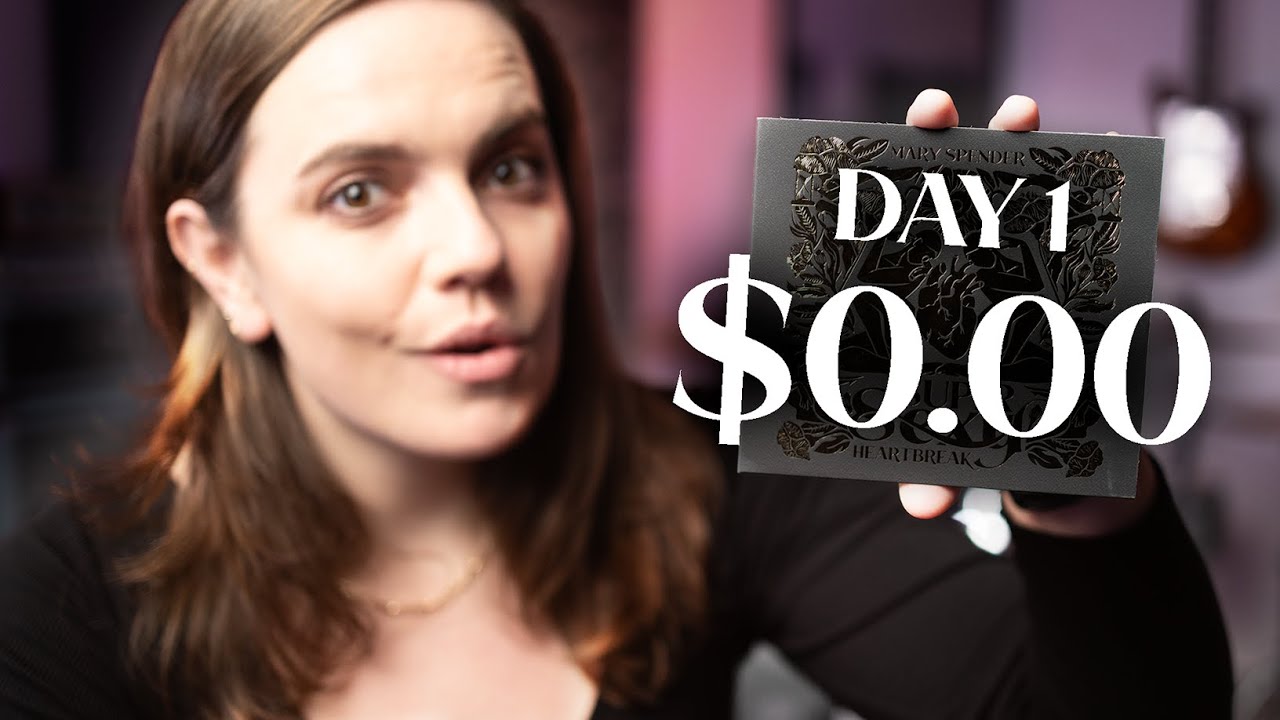
At the start of 2026 I set myself a challenge in public: to see whether I could make $100,000 from my music independently over the course of a year. Not from one viral song, not from chasing an algorithm and not overnight. I know the title sounds very YouTube, and that's intentional, but this isn't really about money. The music is the point, and so are the people who choose to support it.
The declaration
The plan was to independently release two albums in the year and try to make $100,000 from my music: no label, no advances, no middlemen, just songs, an audience and a lot of showing up.
I've done a version of this before
My debut studio album was released completely independently. I self-funded it, paid musicians properly, and spent real money on recording, mixing, mastering, artwork, CDs, vinyl and cassettes. It didn't go viral or get mainstream press, but it worked. The biggest lesson was that streaming barely moved the needle; physical copies saved the project. A small group of people choosing to support work directly is more powerful than a very large group passively consuming it. I explain the numbers behind that in streaming vs physical sales.
So the question was no longer whether it could be done, but whether it could be done again. A debut album has novelty and emotional weight; you only get one first record. If independence only works once, it's a moment, not a model. If you can't repeat an experiment and get similar results, it isn't a system, it's luck.
Why I'm not building around streaming
The vast majority of recorded music revenue now runs through streaming, and that's exactly the model I chose not to build my livelihood around. Not because streaming is bad, but because it's optimised for scale, not sustainability. It works brilliantly if you're massive, if you're background music, or if you're a platform. It doesn't work brilliantly for an independent artist trying to build a stable, human-sized career. I'm not trying to win the industry; I'm trying to build a life.
The plan
- A double acoustic album first. Like Songbook Volumes I and II, it would get songs into the world and fund the next stage. The songs were already written; the work was shaping and refining them, mostly alone in the studio, with the process shared in real time, including the songs that didn't make the cut. The target was delivery in May.
- A live band album later in the year. The strongest songs, recorded live with musicians in the same room: fewer layers, less polish, more commitment. My first album was heavily produced, and it needed to be. This time I wanted bodies, imperfection and energy, inspired by records like Dire Straits' debut, largely tracked live in a short space of time. I write about that approach in recording live in one take.
The rules
This isn't about virality. I'm not assuming a hit, playing the TikTok lottery, or buying reach. Streaming is not the engine. The album would be physical and direct, built on relationships and systems that might look boring from the outside but are honest. I'm not trying to reach everyone; I'm trying to serve the people already here. I see subscriber numbers not as audience size but as votes of confidence. Depth matters more than scale.
An album doesn't make money just by existing. It makes money by being attached to moments, objects, access and stories people want to be part of. That isn't selling out; it's how art has always survived. So alongside the music there would be tangible objects, possibly experiences, probably education, and definitely patronage. Great work exists because people choose to support it. For more on that idea, read what a $99 album taught me about true fans.
Transparent, not gratuitous
It's a year-long experiment. Some months will be quiet and some will spike; the point is survivability, not speed. I still have to make a living, so I'd keep making other videos, teaching and consulting alongside it. I promised to share what works and what flops, the awkward numbers, the boring admin, and the moments I wonder whether I've lost my mind. This isn't advice; it's documentation. If you're a musician, steal whatever's useful. If you're not, enjoy the music and the story.
The first album proved to me that independence is possible. This experiment is about finding out whether it's sustainable. You can find my music and records in my store, and follow the journey through my newsletter.